
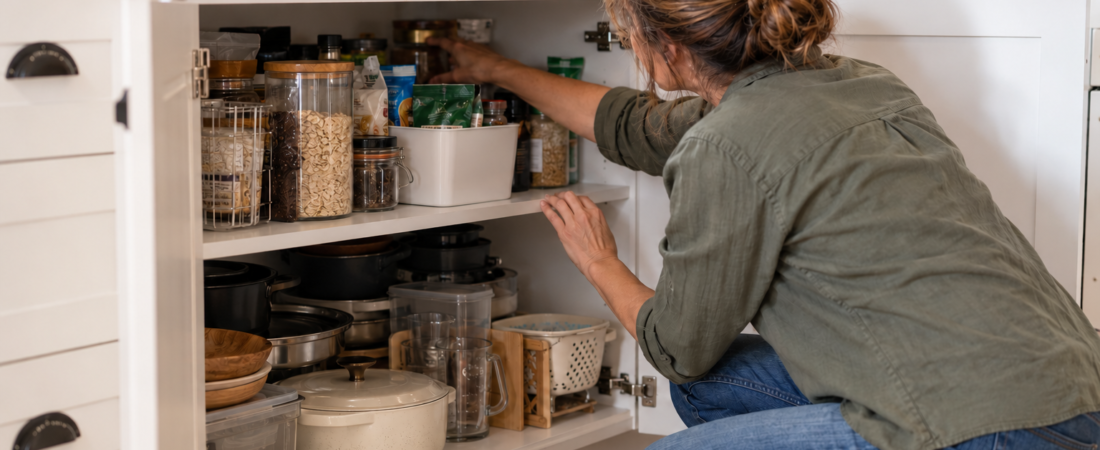
Deep kitchen cupboards seem like a good idea—until half their contents disappear into the back. You end up crouching down, moving five things to reach one, and occasionally discovering something you forgot you owned.
The good news is that you don’t necessarily need new cabinetry to fix the problem. Some of the best solutions are inexpensive, and the right one depends on what is actually making your cupboard difficult to use.
Below, we’ll look at seven practical ways to make deep kitchen cupboards easier to see, reach and use—from fixes that cost nothing to proper pull-out storage.
Before You Buy Anything: Work Out What the Problem Is
A deep cupboard can be frustrating for several different reasons. Things may be hidden behind each other, the shelf may be too low to reach comfortably, there may be wasted height above your food or cookware, or the cupboard may simply contain too much.
That matters because an organiser won’t necessarily fix the wrong problem. Before buying anything, empty the cupboard and decide what you actually need easier access to. Move rarely used items towards the back and keep everyday items within easy reach.
If that solves the problem, stop there. You don’t need an organiser just because there’s space for one.
1. Turn the Shelf Into a Drawer With Removable Bins
One of the simplest fixes for a deep cupboard is also one of the cheapest: use long bins or baskets that you can pull completely out.
Instead of reaching past everything at the front to find something at the back, group similar items together—baking supplies, snacks, packets, cleaning products or food containers—and bring the whole group towards you at once.
You don’t need expensive purpose-built organisers for this. The important things are choosing a bin that makes good use of the depth of your shelf, has a handle or edge that’s easy to grip, and isn’t so large that it becomes heavy when full.
Worth having when: items regularly disappear at the back of the cupboard and you want an inexpensive fix without modifying the cabinetry.
Skip it when: you’re storing heavy appliances, large pots or anything that would make a loaded bin awkward to lift out.
Easier Living: This works particularly well in low cupboards because it brings the contents towards you instead of making you crouch and reach into the back.
2. Use a Turntable When You Need to See Everything
Turntables—often called lazy Susans—can work surprisingly well in deep cupboards, particularly for bottles, jars, sauces, oils and other smaller items that tend to hide behind each other.
Instead of moving the things at the front to reach something at the back, you rotate the turntable and bring it towards you.
But they’re not automatically a good use of cupboard space. A round organiser inside a rectangular cupboard inevitably leaves some unused space around it, and large turntables packed with heavy items can become awkward to rotate.
Worth having when: you store lots of bottles, jars or small containers that you want to see and reach easily.
Skip it when: maximum storage capacity matters more than accessibility, or you’re storing large rectangular containers, pots or appliances.
Easier Living: A turntable can be particularly useful when reaching into the back corner of a cupboard is uncomfortable. Look for one that rotates smoothly without needing much force.
3. Add a Shelf Riser When Depth Isn’t Really the Problem
Sometimes a cupboard looks too deep when the real problem is that you’re only using half its height.
If short jars, mugs, bowls or containers sit on a tall shelf, everything tends to spread backwards. A simple shelf riser creates another level so more items can stay visible near the front.
This can be one of the cheapest cupboard improvements available, but measure carefully before buying one. An organiser that doesn’t fit the things you actually store just creates another obstacle.
Worth having when: there’s a large amount of empty space above shorter items.
Skip it when: the cupboard is already vertically crowded or you regularly store tall items.
Easier Living: Keeping frequently used items visible and at the front can reduce unnecessary reaching and moving things around.
Worth Having example: IKEA VARIERA Shelf Insert — a simple, inexpensive option when wasted vertical space is the real problem.
4. Retrofit a Simple Pull-Out Drawer
This is where I’d consider spending a little more.
A pull-out drawer or sliding basket can turn an ordinary fixed cupboard shelf into storage that comes towards you.
That’s particularly useful in deep lower cupboards. Instead of kneeling down and reaching into the back, you pull the contents into view.
There are inexpensive versions that sit or mount inside an existing cupboard, as well as sturdier systems that attach properly to the cabinetry.
Before buying one, measure the inside width, depth and height of the cupboard—not just the cabinet door. Check for hinges, pipes and door frames that might prevent the drawer from sliding out.
Also check the weight capacity. A lightweight organiser suitable for packets and plastic containers may not be appropriate for tins, cookware or appliances.
Worth having when: you use the cupboard frequently and constantly have to reach past things to get to the back.
Skip it when: the cupboard holds only a few large objects that are already easy to remove.
Easier Living: This is one of the strongest options for reducing crouching and deep reaching because the storage itself comes towards you.
Worth Having example: Olla Pull-Out Steel Cabinet Tray
A straightforward retrofit option for deep lower cupboards. It brings the contents of the shelf towards you, has a 20 kg capacity and can be installed using adhesive strips or screws. Measure your cupboard carefully first—the tray is 26 cm wide and 37 cm deep.
5. Use Individual Sliding Shelves for Heavy or Frequently Used Items
For cupboards containing cookware, tins, appliances or other heavier items, a proper sliding shelf or drawer can make more sense than lightweight organisers.
Individual pull-outs also have an advantage over some tall pantry mechanisms: you only pull out the shelf you need rather than moving the weight of the entire cupboard contents at once.
Quality matters more here. Cheap runners loaded beyond their capacity are unlikely to remain smooth or useful for long.
If you’re comfortable with DIY, some systems can be retrofitted to existing cabinetry. Otherwise, installation may be worth paying for—particularly if the drawer will carry substantial weight.
Worth having when: you regularly access heavy items stored in a deep lower cupboard.
Skip it when: the cupboard is rarely used or a simple removable basket solves the problem adequately.
Easier Living: A smooth sliding shelf can substantially reduce the amount of lifting, bending and reaching involved in accessing heavier kitchen items.
6. Don’t Forget the Dark
Sometimes storage isn’t particularly badly designed—you simply can’t see what’s in it.
Deep lower cupboards, corner cabinets and pantries can be surprisingly dark, particularly when your body blocks the room light as soon as you crouch in front of them.
A small rechargeable motion-sensor light can be a very inexpensive improvement.
Mounting one inside the cupboard means the light comes on when the door opens or movement is detected. Rechargeable magnetic versions can usually be removed easily when they need charging.
It’s a small improvement, but being able to see the back of a cupboard makes it much easier to find what you need without pulling everything out.
Worth having when: you regularly use a dark pantry, deep cupboard or under-sink space.
Skip it when: the cupboard already has good visibility from the room lighting.
Easier Living: Better visibility can be just as useful as better storage, particularly in low cupboards where getting closer simply to see what’s inside is inconvenient.
Worth Having tip: Before buying more storage, try adding light. A small rechargeable motion-sensor light can be enough to make a dark cupboard significantly easier to use, especially in deep lower cupboards and under-sink areas.
7. Consider Proper Pull-Out Cabinetry—but Only When It Makes Sense
At the expensive end are purpose-built pull-out pantries, corner mechanisms and internal drawer systems.
These can transform awkward storage, particularly when you’re renovating a kitchen anyway.
But they’re not automatically the best answer.
Large pull-out pantries can become heavy when fully loaded, and complicated corner mechanisms sometimes sacrifice usable storage space in exchange for accessibility.
That’s not necessarily a bad trade. If easier access matters more to you than squeezing every possible centimetre out of the cupboard, it may be exactly the right choice.
The important thing is to think about how you’ll actually use the cupboard, rather than being impressed by a clever mechanism in a showroom.
Worth having when: you’re renovating, the cupboard causes a persistent problem and improved access matters enough to justify the cost.
Skip it when: a $20–$50 solution would solve the same problem.
Easier Living: Good cabinetry can bring stored items into comfortable reach rather than requiring you to bend, stretch or rummage through deep cupboards.
So Which Deep-Cupboard Fix Is Actually Worth Having?
Start with the cheapest solution that fixes the actual problem.
If things simply disappear behind each other, try removable bins.
If bottles and jars are difficult to see, try a turntable.
If you’re wasting vertical space, add a shelf riser.
If you’re constantly crouching and reaching into a lower cupboard, a pull-out drawer or sliding shelf may be worth paying more for.
And if you’re renovating anyway, that’s the time to consider whether proper drawers or pull-out cabinetry would make the kitchen easier to use for years to come.
The most expensive solution isn’t automatically the best one.
A good storage solution should make the cupboard easier to use, not simply fit more things into it.
Our Worth Having Verdict
For most existing kitchens, we’d start with removable bins or a simple pull-out drawer before spending serious money on cabinetry.
They’re relatively inexpensive, don’t require a kitchen renovation and address the main problem with deep cupboards: the things you need are somewhere you can’t comfortably see or reach.
If a cheap solution works, that’s enough.
Because the point isn’t to have a perfectly organised cupboard.
It’s to be able to open the door, find what you need and get on with your day.