
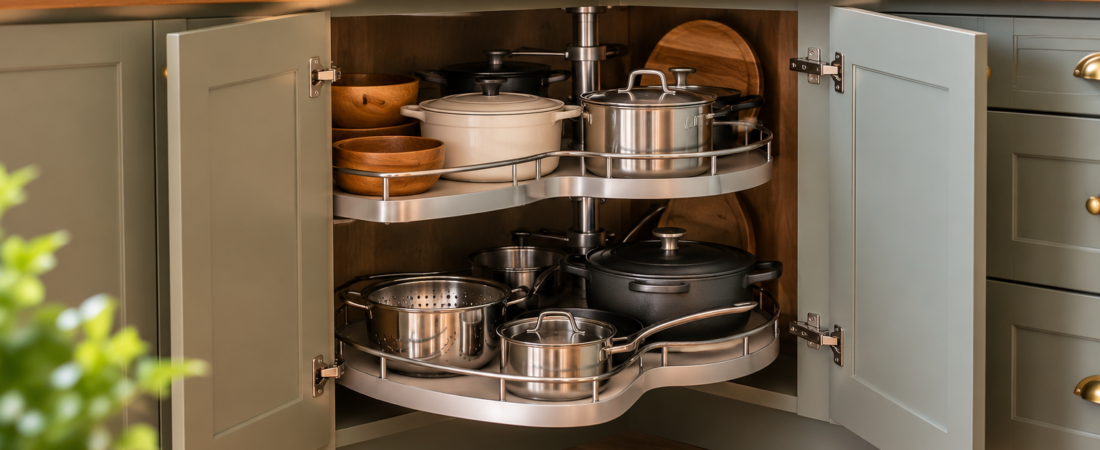
Corner kitchen cupboards can look generous on a floor plan and still be some of the most frustrating storage in the kitchen.
The opening is often narrow, the cupboard stretches much farther than you can comfortably reach, and anything pushed into the back can effectively disappear. Before long, you’re crouching on the floor, moving pots out of the way and reaching around a corner just to find one thing.
There are plenty of products designed to solve this problem. Some are genuinely useful. Others are expensive mechanisms that take up a surprising amount of the cupboard they’re supposed to improve.
Before spending hundreds of dollars, it helps to work out what is actually wrong with your corner cupboard.
Here are seven ways to make an awkward kitchen corner easier to use, starting with the solutions that cost little or nothing.
Before You Buy Anything
Empty the cupboard completely.
It sounds obvious, but a corner cupboard often feels worse simply because too many things have gradually accumulated in it.
Before buying an organiser, decide what actually deserves to live there.
Items used every day should be easy to reach. Things used only occasionally—large serving platters, spare appliances, cake tins or entertaining pieces—can usually tolerate the less accessible areas.
Then ask yourself:
Is the problem that I can’t see what’s there, can’t reach it, or both?
That distinction matters.
A turntable can solve a visibility problem. A pull-out mechanism can solve a reach problem. Neither necessarily fixes a cupboard that’s simply overcrowded.
If reorganising the cupboard solves the problem, stop there.
You don’t need to buy a clever corner mechanism just because one exists.
1. Give the Back Corner to Things You Rarely Use
The cheapest solution costs nothing.
Instead of trying to make every centimetre of a deep corner cupboard equally convenient, accept that some of it simply isn’t prime storage.
Put rarely used items in the deepest section and keep everyday cookware, bowls or appliances close to the opening.
This works particularly well if you have bulky items that take up space but aren’t used every week.
Worth having when: You already have enough storage and the main problem is poor organisation.
Skip it when: You genuinely need regular access to the entire cupboard.
Easier Living: Keeping frequently used items within comfortable reach reduces unnecessary crouching, stretching and unloading of the cupboard.
2. Use Removable Bins or Baskets
A simple basket can turn a difficult shelf into something closer to a makeshift drawer.
Instead of reaching past several individual items, pull the whole basket towards you.
This works best for groups of relatively light things—baking supplies, food containers, packets, tea towels or cleaning products.
Choose containers with handles and don’t make them too large. A huge basket filled with heavy items simply replaces one problem with another.
Before buying anything, measure both the cupboard and the door opening. The internal space may be large while the opening is surprisingly narrow.
Worth having when: Smaller items keep disappearing into the cupboard.
Skip it when: The contents are heavy enough to make the basket awkward to lift or pull.
Easier Living: Handles and removable containers can reduce the amount of reaching around inside a deep cupboard.
3. Try a Turntable for Smaller Items
A turntable—or lazy Susan—is one of the simplest ways to bring items at the back towards you.
Instead of reaching around bottles and jars, rotate the platform until the item you want comes to the front.
They’re particularly useful for pantry items, oils, sauces and smaller containers.
But there’s a trade-off.
A round organiser inside a rectangular cupboard inevitably leaves some unused space around it. That’s not necessarily a problem if easier access matters more than squeezing every possible item into the cupboard.
Avoid overloading it with heavy cookware. A turntable that’s difficult to rotate isn’t much of an improvement.
Worth having when: You store lots of smaller items and struggle to see what’s behind them.
Skip it when: Maximum storage capacity is more important than easy access.
Easier Living: Rotating storage can bring items towards you rather than requiring you to reach into the back corner.
4. Consider a Proper Corner Carousel
A built-in carousel takes the turntable idea much further.
Instead of placing a small organiser on a shelf, large rotating shelves use much more of the corner cabinet and allow sections of the cupboard to rotate towards the opening.
This can work particularly well for pots, pans and dry goods. IKEA, for example, describes its corner carousel as a way of rotating stored items into reach; its current Australian corner-base carousel is around $190.
But measure carefully before buying.
Corner cupboards vary considerably in shape, door configuration and dimensions, and these systems are not universally interchangeable.
Worth having when: You have a compatible corner cupboard and want better access without replacing the cabinetry.
Skip it when: Your existing cupboard dimensions or door configuration aren’t suitable.
Easier Living: A rotating shelf can substantially reduce the need to reach into the deepest part of a corner cupboard.
5. Retrofit a Blind-Corner Pull-Out
If your cupboard extends sideways into a space you can barely reach, a blind-corner pull-out can be a more substantial solution.
These systems use sliding baskets or shelves that move out through the cupboard opening, bringing stored items with them.
Bunnings describes blind-corner pull-out baskets specifically as a way to provide easier access to hard-to-reach areas at the back of corner cupboards.
This is where the price starts climbing. IKEA Australia currently lists a corner-base pull-out fitting at around $250, before considering whether other cabinet components or installation are required.
And complicated hardware isn’t automatically better.
A pull-out mechanism itself occupies cabinet space, so you may gain accessibility while losing some raw storage capacity.
For many households, that’s a worthwhile exchange. For others, it isn’t.
Worth having when: The back section of the cupboard is effectively unusable and you want regular access to it.
Skip it when: You’re trying to maximise every litre of storage or the cupboard isn’t compatible with the mechanism.
Easier Living: Bringing shelves towards you can dramatically reduce deep reaching and rummaging.
6. Improve the Lighting Before Rebuilding the Storage
Sometimes the cupboard isn’t impossible to reach—it’s impossible to see.
Deep corner cupboards can be surprisingly dark, particularly when the kitchen lighting is behind you as you crouch in front of them.
A small rechargeable motion-sensor light can make the contents much easier to identify.
It’s one of the cheapest things worth trying before committing to new hardware.
Worth Having tip: If you can reach the cupboard reasonably well but can’t see what is in the back, try lighting before buying an expensive storage mechanism.
Worth having when: Poor visibility is contributing to the problem.
Skip it when: You already have good visibility and physical access is clearly the issue.
Easier Living: Better visibility means less searching, shifting and reaching for the wrong item.
7. If You’re Renovating, Question the Corner Cupboard Itself
If you’re designing a new kitchen, the best corner-cupboard solution may be not creating the same problem again.
Corner drawers, better-planned drawer banks or deliberately sacrificing some inaccessible corner space can sometimes create a kitchen that’s easier to use—even if the theoretical storage volume is slightly lower.
Bunnings includes corner drawers alongside pull-out carousels as a way to make awkward kitchen corners more accessible.
Australian renovation discussions also show why this matters: homeowners regularly question layouts containing several corner cupboards because a kitchen can appear to have plenty of storage while much of it isn’t particularly functional.
This is an important distinction:
More storage space isn’t necessarily better storage.
A slightly smaller drawer that opens fully and lets you see everything may be more useful than a cavernous cupboard that requires getting onto the floor to reach the back.
Worth having when: You’re already replacing cabinetry and can solve the problem at the design stage.
Skip it when: Your existing cupboard can be made perfectly usable with a much cheaper retrofit.
Easier Living: Designing frequently used storage around comfortable reach can make the kitchen substantially easier to use over the long term.
So Which Corner Cupboard Fix Is Best?
Start with the problem, not the product.
If the cupboard is simply overcrowded, reorganise it.
If small things disappear, try baskets.
If you can’t see what’s at the back, try a turntable or better lighting.
If you regularly need access to a large inaccessible corner, a carousel or pull-out mechanism becomes much easier to justify.
And if you’re renovating anyway, that’s the time to question whether a traditional corner cupboard deserves to be there at all.
The expensive option isn’t automatically the best one.
Our Worth Having Verdict
For an existing kitchen, we’d start with the cheapest reversible solution that addresses the actual problem.
A basket, turntable or better lighting may be enough.
A proper carousel or blind-corner pull-out becomes worth having when the cupboard contains useful space that you genuinely need but can’t comfortably access. Current Australian systems can cost around $190–$250 just for the mechanism, so that’s a meaningful purchase rather than an organiser to buy on impulse.
And if you’re planning a new kitchen, prioritise usable storage over maximum storage.
A cupboard isn’t doing much for you if half of it might as well be inaccessible.