
Affiliate disclosure: Worth Having may earn a commission if you buy through links on this page, at no extra cost to you. Our recommendations are based on research and practical usefulness, not commission rates.
Portable solar sounds simple: put a panel in the sun, plug it into your battery or power station and collect free energy.
In practice, choosing the right amount of solar for a caravan is less about buying the biggest panel you can carry and more about answering one question:
How much electricity do you need to replace each day?
For travellers who mainly stay at powered sites or recharge while driving, a modest solar setup may be plenty. For people spending several days off-grid while running a fridge, devices and other electrical equipment, considerably more solar may make sense.
This guide explains how to estimate what you actually need — without turning it into an electrical engineering exercise.
The Short Answer
For light power use, around 100–200W of portable solar can be useful.
For more regular off-grid use, 200–400W or more may be appropriate, particularly if you’re trying to replenish a substantial amount of battery capacity every day.
But those numbers are only starting points.
The right amount depends on how much electricity you use, how long you stay off-grid, your battery or power-station capacity, whether you also charge while driving, where and when you travel, shade and weather, panel positioning, and the maximum solar input your system can accept.
Start With Energy Use, Not Panel Size
A common mistake is deciding that you “need a 200W panel” before working out what you’re actually trying to power.
Instead, estimate your daily electricity consumption.
The basic calculation is:
Watts × hours used = watt-hours (Wh)
For example, a 40W appliance running for five hours would theoretically consume:
40W × 5 hours = 200Wh
Do this for the main things you expect to run in a typical day — such as a fridge or fridge/freezer, phones, laptops, lights, fans, cameras, water pumps and television.
Some appliances cycle on and off rather than running continuously, so simply multiplying their maximum wattage by 24 hours can greatly overstate actual consumption. Manufacturer energy-consumption figures or your own measured consumption are more useful where available.
You don’t need a perfectly precise figure. You’re trying to establish whether your normal day uses something closer to a few hundred watt-hours or well over 1,000Wh.
That difference matters.
What Does a 100W, 200W or 400W Solar Setup Mean?
Solar-panel wattage is its rated maximum output under specified test conditions. It isn’t a promise that a 200W panel will continuously produce 200W whenever the sun is out.
Still, the ratings are useful for comparing system sizes.
Around 100W
A 100W portable panel can make sense for relatively light electricity use or supplementary charging — think phones, lights and other modest loads rather than trying to support a heavily electrified campsite.
It can also suit travellers who recharge from mains power regularly and simply want solar to extend the time between charges.
Around 200W
This is a more useful starting point for many portable caravan setups.
With suitable conditions and equipment, 200W gives you substantially more ability to replace everyday consumption without becoming particularly cumbersome.
It can be a sensible match for people running a fridge and smaller electrical loads, provided their overall consumption isn’t excessive.
Around 400W and above
Larger arrays become more useful when you’re regularly spending days away from powered sites.
They can also make sense if you have a larger battery bank, substantial daily electricity consumption, refrigeration running continuously, frequent laptop/device charging or inverter-powered appliances.
High-power appliances such as induction cooktops, coffee machines and air conditioners can consume energy much faster than modest solar systems can replace it.
Don’t Expect the Rated Wattage All Day
This is one of the most important things to understand before buying solar.
A panel marked 200W does not mean:
200W × daylight hours = guaranteed daily production.
Actual output changes with time of day, season, location, cloud, shade, panel angle, panel temperature, dirt and dust, and the capability of the charging equipment.
Even fixed caravan panels are normally mounted flat because it’s practical, not because it’s the ideal angle for solar production.
This is one reason it’s sensible to build some margin into an off-grid system rather than sizing everything around perfect conditions.
Portable Solar Has One Big Advantage: You Can Chase the Sun
Fixed rooftop solar is convenient because it’s always there. Park the caravan and charging can begin without unloading anything.
But there’s an obvious problem:
You often want your caravan in the shade while your solar panels want full sun.
Portable panels let you separate the two.
You can park beneath shade and move the panel into a sunny position. You can also adjust its direction or angle during the day.
That flexibility can make a portable panel useful even when you already have rooftop solar.
The trade-off is effort. Portable panels have to be stored, carried, positioned, connected, moved when necessary and packed away again. They can also be vulnerable to theft or damage if left unattended.
So this isn’t simply a question of which system produces more electricity. It’s also about how you actually travel.
Folding Panels, Solar Blankets or Fixed Panels?
There isn’t one universally best option.
Folding rigid panels
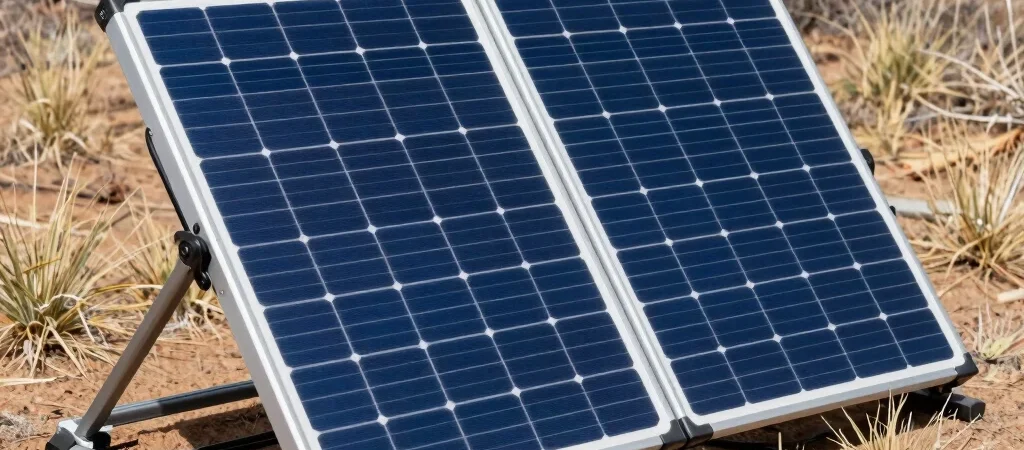
These are often a good compromise between portability and practicality. They’re relatively easy to position and usually have built-in stands that allow them to face the sun.
The downside is bulk and weight.
Solar blankets
Solar blankets can pack into a smaller space, which can be valuable in a caravan or vehicle where storage is limited.
But positioning them effectively can require more thought, and they need to be supported or laid out appropriately.
Fixed rooftop panels
These win on convenience. There’s nothing to unpack, and they can collect energy whenever the caravan is exposed to sunlight.
But you can’t move them independently of the caravan, and a flat roof installation won’t always provide the most productive angle to the sun.
For some travellers, the most useful setup is actually a combination: fixed rooftop solar for convenience plus a portable panel when additional generation is needed.
Matching Solar to a Portable Power Station
If you’re still deciding whether a portable power station makes sense for your setup, see our guide to Portable Power Stations for Caravans: Are They Worth It?
This is where buyers need to be careful.
A power station advertised as accepting solar does not necessarily accept every solar panel.
Before connecting a panel, check the power station’s:
• solar input voltage range
• maximum solar input current
• maximum solar input wattage
• required connector
These specifications can vary considerably between models.
For example, EcoFlow currently specifies a maximum solar input of 110W for the RIVER 3 and 220W for the RIVER 3 Plus, along with different voltage and current limits.
So buying a larger panel does not automatically mean your power station can use all of its output.
Wattage isn’t the only specification that matters.
Voltage is particularly important. When panels are connected together, the electrical characteristics of the array change. The resulting voltage and current must remain within the charging equipment’s permitted input range.
If you’re unsure, check the manuals for both the solar panel and the device being charged before connecting them.
What About a Conventional Caravan Battery System?
If your solar is charging a caravan battery rather than plugging directly into a portable power station, the solar controller becomes an important part of the system.
The controller regulates power coming from the panels before it reaches the battery.
It needs to be suitable for the solar array, system voltage, battery setup and the panel voltage/current.
The controller also places limits on how much solar can sensibly be connected.
If you’re altering a permanently installed caravan electrical system rather than simply connecting a manufacturer-approved portable panel to a compatible portable power station, professional advice can be worthwhile.
Solar Doesn’t Have to Do All the Work
Another common mistake is treating solar as though it must provide 100% of your charging.
Consider what other charging opportunities you already have:
• mains charging at caravan parks
• charging while driving
• DC-to-DC charging
• generator charging, where appropriate
• solar
If you move frequently and recharge effectively while driving, you may need much less solar than someone who parks off-grid in one location for a week.
Likewise, someone who spends most nights at powered caravan sites may get little benefit from carrying a large portable solar array.
This is why two caravanners with similar batteries can reasonably choose completely different solar setups.
Good. Final block. Paste this directly underneath:
What Features Are Worth Paying For?
For portable caravan use, practical features matter more than marketing claims.
Appropriate electrical specifications
Compatibility comes first. A well-made panel isn’t useful if it doesn’t suit the equipment you’re trying to charge.
Check voltage, current, wattage and connector requirements before buying.
Manageable size and weight
A panel that is unpleasant to unpack may eventually stay packed away.
Check both its operating dimensions and its packed dimensions, and make sure you have somewhere practical to store it.
Useful cable length
One of portable solar’s main advantages is being able to put the panel in the sun while keeping the caravan or power station somewhere more suitable.
But excessively long or undersized cables can introduce electrical losses, so use appropriate cabling rather than simply adding whatever extension happens to fit.
Solid construction
Hinges, stands, handles, cables and connectors may be repeatedly packed, transported and exposed to outdoor conditions.
For regular travellers, durability matters.
Efficient panels
Most modern portable panels use monocrystalline solar cells. Their relatively high efficiency is useful when available space is limited — something that matters in caravans, campervans and 4WDs.
Common Solar Buying Mistakes
Buying by wattage alone
A 400W panel isn’t automatically better than a 200W panel if your charging equipment can’t accept the additional power or you don’t have room to transport it.
Assuming advertised output is guaranteed
Rated output is useful for comparison. It isn’t guaranteed real-world production.
Ignoring shade
Even a campsite that looks sunny can have trees, awnings or other objects casting shade across the panels during parts of the day.
Portable solar gives you the ability to reposition the panel, but only if you actually have somewhere sunny to put it.
Forgetting storage
A large folding panel has to travel somewhere.
Measure the storage location before buying.
Ignoring your other charging sources
If you regularly recharge while driving or spend most nights on powered sites, buying an enormous portable array may solve a problem you don’t actually have.
Buying more battery without enough ability to recharge it
A large battery gives you more stored energy, but eventually that energy has to be replaced.
Battery capacity and charging capacity need to make sense together.
So How Much Solar Should You Buy?
Instead of starting with a product, work through this order:
1. Estimate your normal daily electricity use.
2. Decide how many days you typically spend away from mains power.
3. Account for charging while driving or from other sources.
4. Check the solar-input limits of your battery system or portable power station.
5. Decide how much panel size and weight you’re realistically willing to carry.
6. Allow some margin for imperfect solar conditions.
Only then choose the panel capacity.
For occasional camping with relatively light electricity use, that may lead you towards 100–200W.
For regular caravan travel and more substantial off-grid use, 200–400W may be a more useful range.
For large batteries, long off-grid stays and significant electrical consumption, 400W or more may make sense — provided your system can safely accept and use it.
These are starting ranges, not universal prescriptions.
Is Portable Solar Worth Having?
For the right traveller, yes.
Portable solar is particularly useful if you spend meaningful time away from powered sites, want to keep a fridge and devices running, already own a compatible portable power station, park the caravan in shade while panels can be positioned in sunlight, or want to extend off-grid stays without relying entirely on another charging source.
It’s less compelling if you mostly stay at powered caravan parks, drive frequently and recharge effectively from the vehicle, use very little electricity, already have sufficient fixed solar, or simply dislike unpacking and repositioning equipment.
The goal isn’t to collect as many solar watts as possible.
The useful system is the one that can replace the energy you normally use, fits the way you travel, and works within the limits of the equipment you already own.
That’s what makes it worth having.
Sources
Enerdrive — How much solar do I need?
Enerdrive — Should I mount my solar panels flat or at an angle?
Enerdrive — What size Enerdrive MPPT Solar Controller do I need?
Enerdrive — What is the difference between Mono and Poly panels?
EcoFlow — RIVER 3, RIVER 3 Plus and DELTA Pro 3 manufacturer specifications and solar-input guidance.