
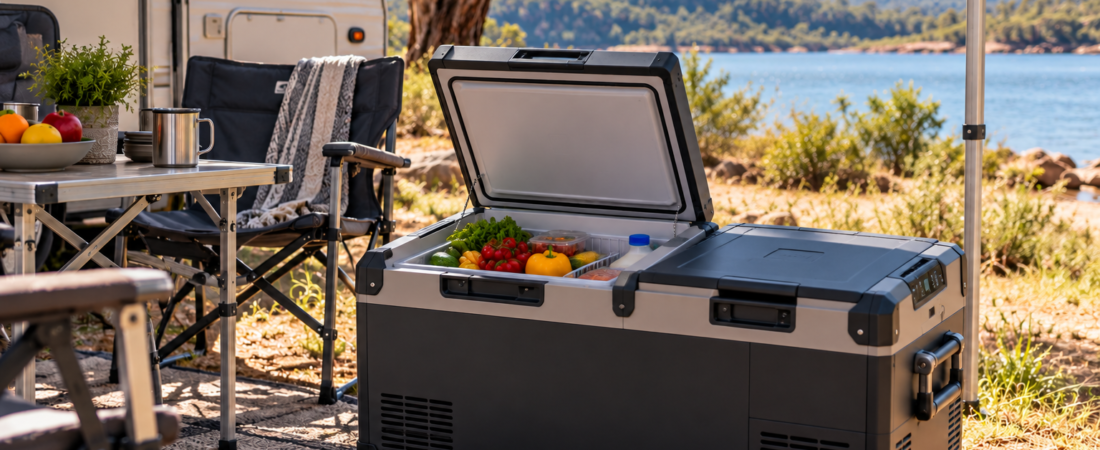
Affiliate disclosure: Worth Having may earn a commission if you buy through links on this page, at no extra cost to you. Our recommendations are based on research and practical usefulness, not commission rates.
A portable fridge/freezer can be one of the most useful upgrades for caravan and camping travel — but it’s also easy to spend far more than necessary or buy a fridge that doesn’t suit the way you actually travel.
Capacity gets most of the attention, but it isn’t the only thing that matters. Power consumption, single or dual-zone operation, physical size, weight, temperature control, ventilation and the electrical system powering it can make a bigger difference in everyday use.
This guide looks at what is worth paying for, what you can probably skip, and how to choose a portable fridge/freezer that earns the space it takes up.
The Short Answer
For most buyers, the best portable fridge/freezer isn’t necessarily the biggest or most expensive model.
Look for a unit that:
• has enough usable capacity for the way you travel
• fits the space where you intend to carry it
• can operate efficiently from your available power supply
• maintains safe and consistent temperatures
• has appropriate 12/24V DC capability for vehicle or caravan use
• has adequate ventilation around the compressor
• isn’t so heavy that moving it becomes impractical
• has useful warranty and service support
Features such as app control, displays, USB ports and multiple compartments can be useful, but they shouldn’t take priority over refrigeration performance, power requirements and practical fit.
Start With Capacity — But Don’t Automatically Buy Bigger
Portable fridge/freezers are usually described by their capacity in litres.
More capacity sounds better, but every increase generally means more physical space, more weight and potentially more energy required to keep the contents cold.
A smaller fridge may be perfectly adequate for a couple taking shorter trips, particularly if food can be replenished regularly.
A larger fridge becomes more useful for families, longer trips, remote travel or anyone wanting to carry several days of fresh and frozen food.
Before deciding on capacity, think about:
• how many people you’re feeding
• how long you normally travel between food shops
• how much fresh food you carry
• whether you need frozen storage
• whether drinks need to share the same fridge
• where the fridge will physically live
Then measure that space.
Don’t rely on the advertised litre capacity alone. Check the external dimensions of the actual fridge, and allow additional room for ventilation, cables and opening the lid.
Single Zone or Dual Zone?
This is one of the biggest decisions when choosing a portable fridge/freezer.
Single-zone models have one temperature-controlled compartment. You normally use the whole unit as either a refrigerator or a freezer.
They’re relatively simple and can be a good choice if refrigeration is all you need.
Dual-zone models provide two independently controlled areas on suitable models, allowing you to refrigerate food in one compartment while freezing food in the other.
That flexibility is valuable for longer trips, but don’t pay extra for dual-zone capability simply because it sounds better.
If you rarely carry frozen food, the extra complexity and divided storage may provide little benefit.
For many travellers, a well-sized refrigerator is more useful than an oversized dual-zone fridge/freezer with freezer space they rarely use.
Temperature Control Matters More Than Gadgets
A portable fridge has one fundamental job: keep food at an appropriate temperature.
Food Standards Australia New Zealand advises that potentially hazardous refrigerated food should generally be kept at 5°C or colder.
That makes reliable temperature control considerably more important than whether the fridge has an app or an impressive control panel.
A digital temperature display is useful, but for important food storage, an independent fridge thermometer can provide an inexpensive additional check.
Also remember that frequently opening the lid, putting warm food inside, poor ventilation and high ambient temperatures can all make the fridge work harder.
How Much Power Does a Portable Fridge Use?
This is where portable fridge/freezers differ from many other caravan appliances.
A compressor fridge does not normally draw its rated power continuously. The compressor cycles on and off as required to maintain temperature.
Actual energy consumption depends on factors including:
• fridge size and design
• temperature setting
• ambient temperature
• how often the lid is opened
• how much warm food or drink is added
• ventilation around the fridge
• whether part of the unit is operating as a freezer
• insulation and overall efficiency
For that reason, a fridge’s maximum wattage doesn’t tell you exactly how many watt-hours it will consume over 24 hours.
When comparing models, look for manufacturer energy-consumption information where available rather than judging efficiency from maximum wattage alone.
Why Fridge Efficiency Matters Off-Grid
At a powered caravan site, modest differences in fridge consumption may not matter much.
Off-grid, they can matter considerably.
Your fridge may need to run 24 hours a day, making it one of the most consistent loads on your battery system.
For example, if a fridge averaged 30W over a full day after compressor cycling is taken into account, the theoretical daily consumption would be:
30W × 24 hours = 720Wh
That is only an example, not an expected consumption figure for every fridge. Real-world consumption varies significantly.
The important point is that even a relatively modest continuous average becomes substantial when multiplied across an entire day.
This is why fridge choice, battery capacity and charging capability should be considered together.
Running a Fridge From a Portable Power Station
Portable power stations can be a convenient way to run a portable fridge, particularly when you don’t want to modify the caravan’s permanent electrical system.
But check the numbers before buying.
You need to consider:
• the fridge’s voltage and power requirements
• the power station’s usable battery capacity
• the appropriate DC output
• how long you expect the fridge to operate between charges
• how you’ll recharge the power station
Where possible, running a compatible portable fridge directly from a power station’s DC output can avoid the conversion losses involved in turning battery DC into AC through an inverter and then converting it again inside an appliance power supply.
Always follow the fridge and power-station manufacturers’ connection requirements.
If you’re still deciding whether a portable power station suits your caravan, see our guide to Portable Power Stations for Caravans: Are They Worth It?
Solar and Portable Fridges
A fridge and portable solar can work particularly well together because solar can replenish some of the energy the fridge consumes during the day.
But don’t assume that buying a particular wattage of solar guarantees continuous fridge operation.
Solar production varies with weather, season, shade, panel position and the limits of your charging system.
The useful question is:
Can your charging setup replace roughly as much energy as you normally consume over time?
For more on sizing portable solar, see our guide to Portable Solar for Caravans: How Much Solar Do You Actually Need?
Ventilation Is Easy to Overlook
Compressor refrigerators move heat from inside the cabinet to the surrounding air.
That heat needs somewhere to go.
If a portable fridge is wedged tightly into an enclosed compartment with poor airflow, the refrigeration system may have to work harder.
When measuring your intended fridge space, don’t just check whether the cabinet physically fits.
Check the manufacturer’s required ventilation clearances and consider where the compressor vents are located.
A few extra centimetres of space can be more useful than squeezing in the largest fridge that will technically fit.
Hot Weather Changes the Equation
Australian caravan travel can expose a portable fridge to demanding conditions.
A fridge sitting inside a hot vehicle, enclosed storage compartment or direct sunlight may have to work considerably harder than the same fridge operating in a mild environment.
Practical measures can help:
• provide the required ventilation
• keep the fridge out of direct sun where practical
• avoid unnecessarily opening the lid
• cool food and drinks before loading them when possible
• don’t obstruct compressor vents
An insulated fridge cover may help in some installations, but it must not obstruct ventilation required by the manufacturer.
Good. Power section + both internal links are done.
Now the final content block. This finishes the article.
Block 3 — practical buying criteria + mistakes + verdict
Paste directly underneath:
What Features Are Actually Worth Paying For?
Once capacity and power requirements are right, some features can genuinely improve day-to-day use.
Low-voltage battery protection
Many portable compressor fridges include selectable battery-protection settings designed to reduce the risk of excessively discharging the vehicle battery.
This is particularly relevant when a fridge is connected to a vehicle electrical system. Check the manufacturer’s instructions rather than assuming the highest or lowest setting is appropriate for your setup.
12/24V DC operation
For caravan, camping and vehicle use, reliable DC operation is one of the most useful capabilities.
If mains operation matters as well, check whether the required AC adaptor is included or sold separately.
A practical lid design
Think about where the fridge will actually sit.
Which direction does the lid open? Can you reach inside when it’s installed? Does it need extra clearance above it?
A fridge that fits perfectly on paper can be frustrating if a wall, bed or storage compartment prevents the lid from opening properly.
Removable baskets
They aren’t exciting, but removable baskets can make loading, cleaning and finding food considerably easier.
Useful handles
Large portable fridge/freezers can become very heavy once loaded. Good handles matter if you expect to move the fridge regularly.
Check the fridge’s empty weight as well as its dimensions.
App control
App control can be convenient, particularly when the fridge is stored somewhere awkward to access.
But we’d treat it as a bonus rather than a reason to choose one fridge over another.
Reliable cooling, sensible power consumption, appropriate capacity and good support matter more.
Warranty and Australian Support
Portable fridge/freezers combine electronics, refrigeration components and equipment that may spend considerable time being transported over rough roads.
Warranty length is worth checking, but so is what happens if something goes wrong.
Before spending heavily, consider whether the brand has accessible Australian warranty support, spare parts and service options.
A bargain fridge becomes much less attractive if it can’t be repaired or supported when something fails.
Common Portable Fridge Buying Mistakes
Buying the biggest fridge that fits
More capacity means little if the fridge becomes difficult to lift, blocks access to other storage or places unnecessary demand on your electrical system.
Buy for your realistic needs rather than maximum possible capacity.
Ignoring external dimensions
Two fridges with similar litre capacities can have quite different external dimensions.
Measure the actual space.
Then allow for ventilation, cables and lid opening.
Paying for a freezer you don’t need
Dual-zone models are useful when you genuinely need simultaneous refrigeration and freezing.
If you don’t, a simpler single-zone model may provide more useful refrigerated space for the money.
Forgetting about loaded weight
A fridge that seems manageable when empty can become very heavy once filled with food and drinks.
This matters both for handling and for overall caravan or vehicle payload.
Ignoring power consumption
Purchase price isn’t the only consideration when you’re travelling off-grid.
A fridge that demands significantly more energy may require additional battery capacity or charging capability.
Assuming every 12V socket is suitable
Check the fridge manufacturer’s electrical requirements and your vehicle or caravan wiring.
Poor connections, inadequate wiring or unsuitable sockets can cause voltage drop and unreliable operation.
Choosing on Features Rather Than Fundamentals
Bluetooth, Wi-Fi, USB outlets and colourful displays are easy to compare in a shop.
They’re secondary.
The fundamentals are still:
Does it fit? Does it keep food reliably cold? Can your electrical system run it? Is it practical to use?
Get those right first.
Who Should Consider Spending More?
A higher-priced portable fridge/freezer can make sense for people who travel frequently, spend long periods off-grid, visit remote areas, rely heavily on the fridge for food storage, or expect the unit to withstand years of regular transport.
In those situations, efficiency, construction quality, service support and reliability can justify paying more.
For occasional weekend camping near towns and powered facilities, the value equation may be different.
You may not need premium features or a very large unit.
Is a Portable Fridge/Freezer Worth Having?
For regular caravan and camping travel, usually yes — provided you choose the right one.
A portable compressor fridge gives you reliable cold storage without relying on ice, makes longer trips easier and can be particularly useful when travelling away from shops and powered sites.
But it’s also a product where buying too much can be just as wasteful as buying too little.
Start with the way you actually travel.
Work out how much food you need to carry, whether you genuinely need freezer space, where the fridge will live and how you’re going to power it.
Then compare products.
The fridge that earns its place isn’t necessarily the biggest or the one with the longest feature list. It’s the one that fits your space, your electrical system and your actual travel habits.
That’s what makes it worth having.
Sources
Food Standards Australia New Zealand — Temperature control requirements for potentially hazardous food.
Manufacturer specifications and operating guidance should also be checked for any individual fridge/freezer, particularly for power requirements, ventilation clearances, battery-protection settings and installation requirements.